A modern society? Nah, not when this country is still home to some ignorant, neanderthal, gun wielding, poison laying farmers and land owners who's value's belong in another century and who's moral and ethical compass is well and truly broken.
http://www.independent.ie/irish-news/whitetailed-eagle-shot-and-starved-to-death-30067176.html
This is not the first and looks like it won't be the last of these magnificent birds to suffer this fate in this the land of a thousand welcomes and all that feckology. We're fast becoming an embarrassment, a country of gobshites and morons, the laughing stock of the international conservation community. But whisper it, because you're not allowed to upset the farming and hunting community in the fair isle of Ireland 2014.
Wednesday, March 5, 2014

Monday, March 3, 2014
Ring-billed Gull - 1st wi
There was a time not too long ago when the Ring-billed Gull was a scarce Winter visitor to these shores from its home in North America. Whilst not exactly common, they have become a much more regular sight all along the shores of Ireland throughout Autumn and Winter.


The bird pictured here is a 1st-Winter Ring-billed Gull that was found in the large mixed flock of Gulls at Dublin port last weekend. Granted the day was all about the Ross's Gull (previous post), however when the Ring-billed was spotted it drew very little reaction from the assembled throng, partly due to the Ross's being the target of the day, and partly due I think to the ever increasing presence of Wintering Ring-billed Gulls in Ireland.
Tuesday, February 25, 2014
Ross's Gull at Poolbeg
I made my way back to Poolbeg (Dublin Port) on Sunday afternoon to see if I could catch up with the Ross's Gull that had been in and around the port for a few weeks. Saturday was a big dip with the Ross's showing up not long after I'd departed, so with the fingers and toes crossed it was to Poolbeg I headed again on Sunday.
The Ross's is a bird from the Arctic Circle and this one was only about the 22nd record ever for Ireland, so it was a bit of a big deal for me, it's not very often the mega birds show up in Dublin, you usually have to travel the length and breadth of the island chasing, so to have such a rarity in your hometown was nice for a change.

Anyway Sunday was windy, cold, damp and occasionally wet, and went from bright sunshine to overcast skies from one minute to the next. Lots of the guys who dipped on Saturday were back for another play at the waiting game along with a few of the other usual suspects.
The Ross's didn't show 'till about 4.00pm and when it did eventually appear it spent a lot of the time down behind the outlet wall (you can see the barbed wire that sits on the wall in one of the shots) and out of view. It appeared to be swimming against the tide up the outflow and then riding the current back down, a process it repeated again and again. The problem here was the the Ross's was hidden from view for much of the time as it stayed down below the wall!
On the odd occasion it did show there was a burst of action from the watching group as shutters opened and closed, tripods were adjusted and shouts went out mostly of the "I cant bleedin' see it, someone spot it for me" type. The locals out walking the South Bull Wall were really curious as to what a group of (mainly) grown men in green anoraks and hats could be getting so exited about. One lady asked were we looking at someone famous to which the reply came ' yeah, Colin Farell is skinny dipping in there'.
The light was poor at this time and although the bird gave intermittent views for about ninety minutes by the time we packed up and decided to call it a day it was almost dark. I don't think anyone managed any really great shots, the two I have here are really the best of the bad bunch I managed.
The Ross's is a bird from the Arctic Circle and this one was only about the 22nd record ever for Ireland, so it was a bit of a big deal for me, it's not very often the mega birds show up in Dublin, you usually have to travel the length and breadth of the island chasing, so to have such a rarity in your hometown was nice for a change.
Anyway Sunday was windy, cold, damp and occasionally wet, and went from bright sunshine to overcast skies from one minute to the next. Lots of the guys who dipped on Saturday were back for another play at the waiting game along with a few of the other usual suspects.
The Ross's didn't show 'till about 4.00pm and when it did eventually appear it spent a lot of the time down behind the outlet wall (you can see the barbed wire that sits on the wall in one of the shots) and out of view. It appeared to be swimming against the tide up the outflow and then riding the current back down, a process it repeated again and again. The problem here was the the Ross's was hidden from view for much of the time as it stayed down below the wall!
 |
| Add caption |
The light was poor at this time and although the bird gave intermittent views for about ninety minutes by the time we packed up and decided to call it a day it was almost dark. I don't think anyone managed any really great shots, the two I have here are really the best of the bad bunch I managed.
Sunday, February 23, 2014
Great Northern Diver
The Great Northern Diver is a common winter visitor to Ireland, it can be found in the seas all around the country. If your luck is in you can get great close up views when they frequent the harbours and ports when the weather turns stormy and the seas get rough. The country has experienced quite a rough winter with wind speeds of well over 100kph being recorded in recent weeks, it's precisely at these stormy times that I head towards the coast to search for sea birds that have been blown to land or have decided to head for some shelter.


I've had literally dozens of Great Northern Divers in the harbours and ports along the East coast in recent weeks, so many in fact that I'm not even sure at this stage where exactly some of these shots have been taken, Loughshinney, Port Oriel, Balbriggan, Annagassan and so on. All I can say for sure is that they've all been taken sometime in the last three weeks.


And by the way, the reason I'm posting this early on a Sunday is that the country is in the midst of another Winter storm right now and I'm waiting on it to pass by before I head out for an afternoon at Poolbeg in Dublin Port chasing a very elusive Ross's Gull that has so far caused me nothing but heartache with dip after bloody frustrating dip. But hey the anticipation and not knowing is more than half the fun, I mean if the bird you were after was always there you wouldn't have the hours and hours of craic standing around and shooting the breeze with your mates now would you!
I've had literally dozens of Great Northern Divers in the harbours and ports along the East coast in recent weeks, so many in fact that I'm not even sure at this stage where exactly some of these shots have been taken, Loughshinney, Port Oriel, Balbriggan, Annagassan and so on. All I can say for sure is that they've all been taken sometime in the last three weeks.
And by the way, the reason I'm posting this early on a Sunday is that the country is in the midst of another Winter storm right now and I'm waiting on it to pass by before I head out for an afternoon at Poolbeg in Dublin Port chasing a very elusive Ross's Gull that has so far caused me nothing but heartache with dip after bloody frustrating dip. But hey the anticipation and not knowing is more than half the fun, I mean if the bird you were after was always there you wouldn't have the hours and hours of craic standing around and shooting the breeze with your mates now would you!
Sunday, February 16, 2014
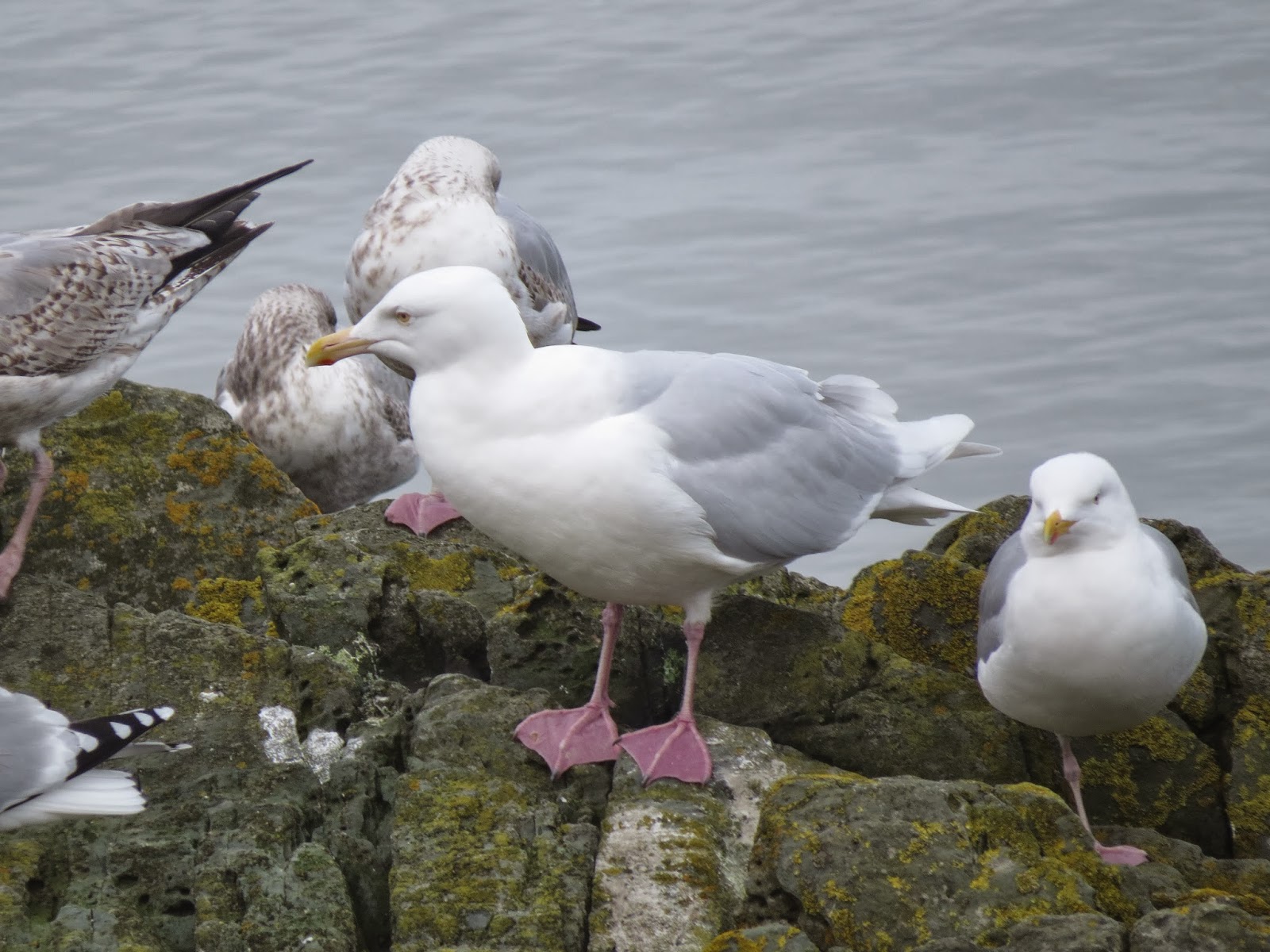
Adult Glaucous Gull
One of the adults (the one pictured here) showed no signs of the brownish streaks on its neck and head you'd normally expect to find on a Winter Glaucous, instead its plumage was completely unblemished and a
 |
| Already has its brilliant white Summer head and neck |

 |
| There's a total absence of coluration or markings on its tail and upper-tail coverts |


Thursday, February 13, 2014
Glaucous Gull
The Glaucous Gull is a common Winter visitor to Ireland from its breeding grounds in Iceland and Greenland. This year there appears to have been a higher number of sightings than most, they have been reported almost daily, along with plenty of Iceland and some Kumliens Gulls. The Glaucous Gull in these shots is a 1st Winter, this one was mixing with the mixed flocks in and around Port Oriel in Co. Louth last weekend.


This particular bird is very pale, the brown almost completely washed out of its plumage which happens this time of the year. A few months ago this bird most likely had a duller, browner appearance. Yesterday there were two 1st Winters and an adult sighted in Port Oriel, at a guess I'd say one of the 1st Winters was this individual.


This was a big bird for a 1st Winter, and when fully grown an adult Glaucous would almost match a Great Black Backed Gull for size, and the Great Black Backed is our largest gull.


This individual was particularly twitchy, constantly taking flight and moving across the harbour, settling down for a while, before moving back across to its position on the nearside rocks with the other gulls.
This particular bird is very pale, the brown almost completely washed out of its plumage which happens this time of the year. A few months ago this bird most likely had a duller, browner appearance. Yesterday there were two 1st Winters and an adult sighted in Port Oriel, at a guess I'd say one of the 1st Winters was this individual.
This was a big bird for a 1st Winter, and when fully grown an adult Glaucous would almost match a Great Black Backed Gull for size, and the Great Black Backed is our largest gull.
This individual was particularly twitchy, constantly taking flight and moving across the harbour, settling down for a while, before moving back across to its position on the nearside rocks with the other gulls.
Saturday, February 8, 2014
Kittiwake

The harbour at Port Oriel was packed full of all manner of gulls and seabirds, all looking for some shelter from the storm. A first Winter Kittiwake kept me amused for some time as it flew out of the harbour only to turn some way out and ride the winds back in, a process it repeated again and again. The Kittiwake is a common enough resident breeding species for Ireland, it's found on cliffs during the breeding season but during Winter it can be found almost anywhere along the coast and in harbours.
 |
| Kittiwake and Seal |


Subscribe to:
Posts (Atom)